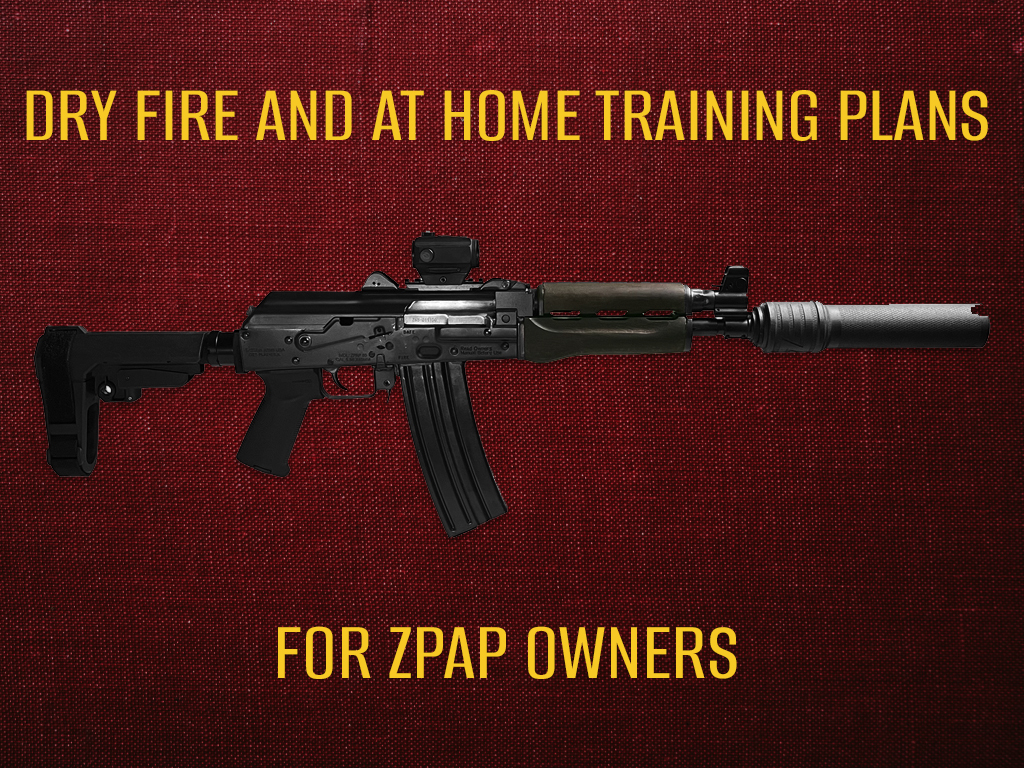
Dry-fire gives that rifle a job even on days without range time.
You run the same trigger, the same selector, and the same stock weld, only without blast, recoil, or ammo bills. Done right, dry-fire sharpens fundamentals, improves gun handling, and supports safer gun ownership.
Here’s a simple, ZPAP-focused dry-fire blueprint that fits real life, not fantasy training montages.
Safety Checks Before Any Dry-Fire Session
Dry-fire practice stays valuable only if safety sits in first place.
Confirm an empty firearm, keep ammo away from your practice area, and point the muzzle at a safe backstop.
Use this pre-session ritual:
- Pick A Safe Direction: Choose a direction that could safely absorb a round in the worst case, such as a sturdy exterior wall or a purpose-built backstop. Never treat drywall as armor.
- Clear The ZPAP With Purpose
- Point the muzzle in that safe direction.
- Remove the magazine.
- Lock the carrier to the rear.
- Look into the chamber, magwell, and bolt face.
- Touch the chamber with a finger as well as your eyes.
- Evict Live Ammo From The Room: Move every live round, every loaded mag, and every ammo can to another space.
- Decide on Snap Caps or Dummy Rounds: Most modern centerfire rifles tolerate dry-fire without damage. If you still feel cautious, use snap caps or inert dummy rounds that match your ZPAP’s caliber.
You run this ritual every time you start, and again after any break. No shortcuts.
Gear That Helps Dry-Fire With Your ZPAP
You never need extra gear for dry-fire, but smart Zastava equipment makes sessions smoother.
- Your Core Rifle: A workhorse option like the ZPAPM70 ZR7762WM Semi-automatic Sporting Rifle gives you a 7.62×39 gas-operated system, 1.5 mm bulged trunnion, and a chrome-lined barrel. That package tracks straight through the press and rewards clean trigger work.
- Factory Accessories: Zastava’s own ZPAP M70 accessories cover mounts, slings, magazines, muzzle devices, and more, all built around ZPAP geometry. A solid sling supports stability during positional dry-fire, and a proper optic mount lets you rehearse real sight pictures instead of wishful ones.
- Cleaning And Lube Support After live sessions, the routine from “Cleaning a ZPAP After a Range Day” keeps the rifle smooth and consistent for both live and dry practice.
Keep the setup simple. Your dry-fire plan should mirror your real rifle, not a cosplay project.
Four-Week At-Home Dry-Fire Plan For ZPAP Owners
Treat this as a menu, not a law.
You adjust drills to your space, your experience, and your local rules. Aim for 10–15 minutes per session, three to five times per week.
Week 1: Safety, Mount, And Selector Discipline
Goal: smooth handling and selector control without any rush.
-
Session A – Mount And Stock Weld
- Clear the rifle with the full ritual.
- Start from low ready.
- Mount the ZPAP to the shoulder, find your cheek weld, and pick a small point on the wall.
- Repeat 10–15 times, then re-check the chamber.
-
Session B – Selector And Trigger Prep
- Start on SAFE, muzzle in a safe direction.
- Sweep to FIRE with the thumb or index finger, depending on your preferred technique.
- Take up slack on the trigger and press straight to the rear.
- Hold the press, cycle the action manually, then reset with the same finger.
Week 2: Sight Picture And Trigger Control
Goal: front-sight or dot focus that refuses to flinch.
-
Session C – Wall Drill
- Tape a small dot to the wall.
- Stand close enough that the front sight or dot almost covers it.
- Press the trigger in slow motion and watch for any wobble.
- If the sight jumps, adjust grip and press again.
-
Session D – Ready-Up With A Timer
- Use a shot timer or phone app with a simple beep.
- At the beep, mount the rifle from low ready and land the front sight on the target.
- Press a single dry-fire shot only after you confirm alignment.
Note your time on a sticky note. Next week, shave a few tenths without losing control.
Week 3: Positions And Reload Flow
Goal: smooth transitions, no circus-level contortions.
-
Session E – Standing To Kneeling
- Choose a safe direction and a low target.
- Start in standing, then drop into kneeling with the muzzle steady and the stock in the pocket.
- Take one dry-fire shot from each kneeling rep.
-
Session F – Dry Reloads With Dummy Rounds
- Use Zastava factory magazines from the magazines section if you want a pure factory stack.
- Set one magazine in the rifle, one on a belt or table.
- Press the trigger, run the selector to SAFE, then cycle a pretend empty mag out and a fresh mag in.
- Return to FIRE and press again.
Week 4: Home-Defense Focus And Light Use
Goal: dry-fire that lines up with a realistic home-defense role.
-
Session G – Light Discipline (Unloaded Rifle)
- If you mount a white light on your rifle, follow the mounting ideas from the ZPAP home-defense article.
- Practice short “on, ID, off” pulses at low ready.
- Press the trigger only on clearly identified “targets” such as a printed silhouette or a simple colored shape.
-
Session H – Simple Movement To Cover
- Pick one piece of “cover” at home: a sturdy corner, not a thin interior door.
- Start from a fixed point, move to that position with the rifle on SAFE, and mount as you arrive.
- Once set, move to FIRE and break one dry-fire shot.
You avoid elaborate “room-clearing” drills. You focus on safe movement, selector discipline, and clear ID.
From Dry-Fire Back To The Range
Dry-fire never replaces live fire, but it multiplies the value of each ZPAP range trip. Writing on dry-fire stresses that point again and again: dry-fire improves trigger control and manipulation; live fire confirms it under recoil.
When you head back to the range:
- Use the same stance, stock length, and optic height that you use at home.
- Warm up with a slow string that mirrors your wall drill.
- After the session, run the post-range routine from cleaning a ZPAP after a range day, so the rifle stays ready for the next block of home practice.
If you want more ideas, the Zastava Arms USA homepage links to a full catalog of ZPAP rifles, accessories, and tech articles that all match the same Zastava-only ecosystem.
Build that loop: safe dry-fire, smart live fire, simple maintenance, and you give your ZPAP a life full of real work, not just safe-queen poses.