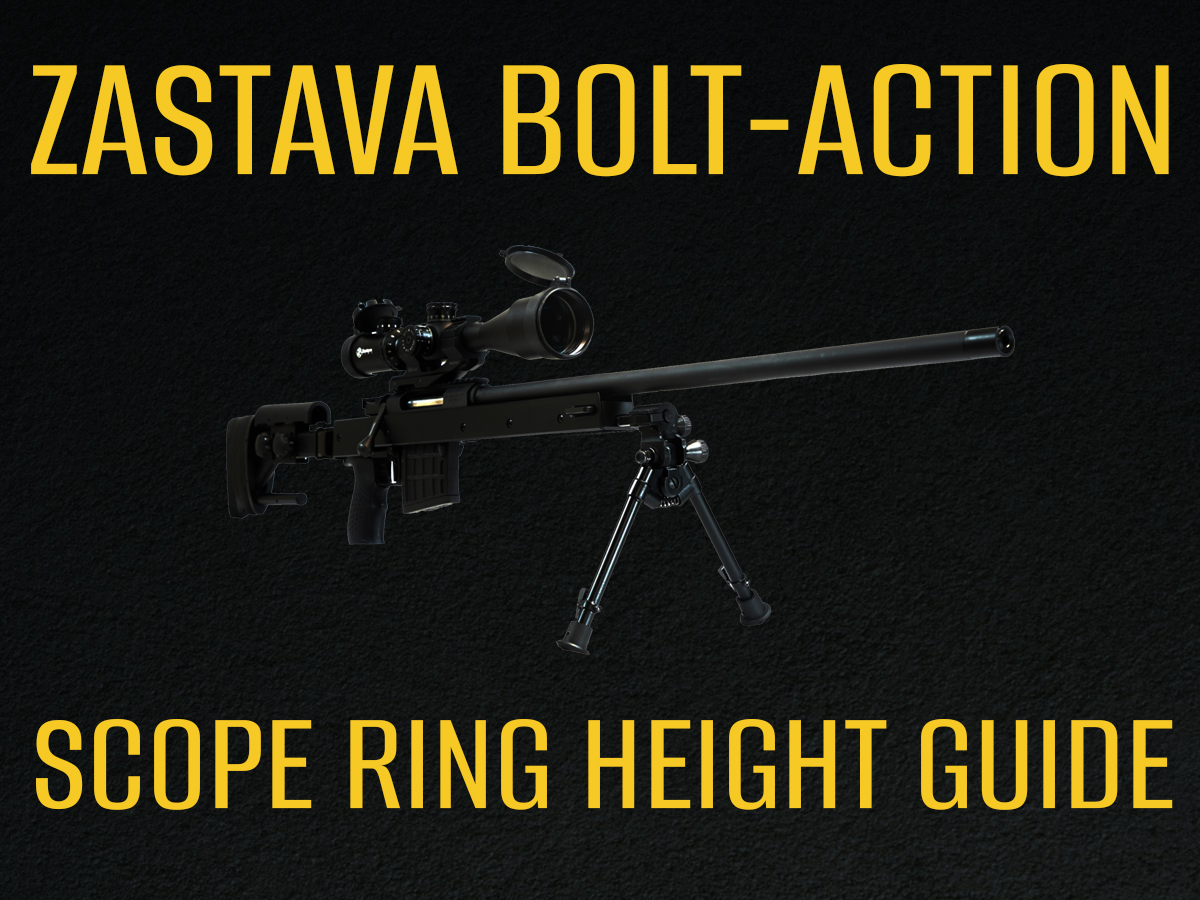
A good scope ring height guide saves you from a classic range-day tragedy: the scope sits too low, the bolt handle argues with it, and your cheek weld feels like a yoga pose gone wrong. Zastava’s current bolt-action lineup gives you several strong platforms to work with, including the LK M85, LK M70 family, M07-AS, and Black Arrow M93. Zastava also notes that the M07-AS comes with an integrated Picatinny rail, which changes ring selection right away.
Why A Scope Ring Height Guide Matters
A real scope ring height guide does more than help the scope clear the barrel. It helps you line up behind the optic with a natural cheek weld, keep the rifle comfortable, and avoid contact with the bolt handle, rear sight, or barrel. Optics manufacturers and mount makers agree on the big idea: choose the lowest setup that clears the rifle and still gives you proper fit and function. Too much height can hurt comfort and consistency.
That matters even more on a Zastava bolt gun, because these rifles cover very different roles. A trim hunting rifle and a heavier precision rifle do not always want the same optic height. The North American Game Guide to Zastava Bolt-Action Rifles shows that spread clearly, from light field rifles to the rail-equipped M07-AS.
Start With The Rifle, Not The Scope Box
Here is the first rule in any honest scope ring height guide: do not start with “50mm objective” and call it a day. You need the outside diameter of the objective bell, not just the advertised lens size. Midway’s ring-height reference states that clearly, and Warne shows why with a formula that uses objective radius, tube radius, and base or rail height.
That little detail trips up a lot of people. A “50mm” scope often measures closer to 56–58mm at the bell, depending on housing shape and design. Warne’s example uses a 50mm scope with an actual 58mm outside objective diameter. So if you skip that measurement, your “perfect” ring choice may become a very expensive lesson in optimism.
The Four Measurements That Decide Everything
A practical scope ring height guide comes down to four measurements.
First, measure the scope tube diameter. A 1-inch tube needs 1-inch rings. A 30mm tube needs 30mm rings. That part sounds obvious, yet every year someone somewhere proves otherwise. Leupold states this directly in its mount guide.
Second, measure the outside objective bell diameter. Again, not the glass size. Measure the bell itself.
Third, measure the base or rail height at the front of the receiver. Warne includes base or rail height in the minimum ring-height formula because the mounting surface changes the whole equation. A rifle with a Picatinny rail can need a different ring height than the same scope on lower-profile bases.
Fourth, check rifle clearance points: bolt handle travel, barrel contour, rear sight if present, and lens cap space. Leupold and other mounting guides stress that the scope must clear the rifle and must not interfere with operation.
How This Scope Ring Height Guide Applies To Zastava Bolt Actions
For Zastava bolt guns, the platform matters a lot.
The M07-AS has a machined-in Picatinny rail and an adjustable stock. That gives you more flexibility with optic setup, and the adjustable stock helps you recover cheek weld if you need slightly taller rings for a larger optic. Zastava’s own product page highlights both the integrated rail and the adjustable cheek position.
The hunting side of the family, such as the LK M85 and LK M70 line, usually calls for a simpler field setup. Zastava’s bolt-action guide frames those rifles as practical hunting tools, often paired with classic low-power or mid-range scopes such as 2-7x, 3-9x, or 4-16x depending on role. The LK M85 article also notes a drilled-and-tapped receiver, which supports straightforward optic mounting on that model.
That means this scope ring height guide should stay flexible. On an M07-AS, medium or even taller rings may make sense with a large objective and your preferred eye position. On a hunting-oriented LK rifle, lower rings often feel better if they still clear the barrel and bolt.
Low, Medium, Or High?
A good scope ring height guide should give you a plain-English starting point.
Low rings often fit smaller objectives and slimmer hunting setups. They work best when you want the optic close to the bore and the rifle stock does not need extra height correction.
Medium rings often land in the sweet spot for many traditional bolt guns. Vortex states that medium rings work well for a great many traditional bolt-action riflescopes, and that advice lines up with what many hunters already know from the field: medium solves a lot of headaches without forcing your head into orbit.
High rings usually enter the chat when you use a larger objective, need extra bolt clearance, run a thicker rail, or want room for caps and accessories. Leupold’s ring pages note that medium rings commonly fit scopes with an objective size of 42–45 mm, while high rings are typically used with scopes around 50mm objective size. That is a helpful starting point, not a universal law carved into stone tablets. Rifle geometry still wins the argument.
This scope ring height guide gets simple fast if you follow a clean process.
Mount choice comes first. Confirm what base or rail fits your Zastava rifle. Zastava’s bolt-action family includes several receiver styles and use cases, so one-size-fits-all logic can get silly in a hurry.
Next, calculate minimum height. Warne’s method uses:
Objective radius – tube radius – base height = minimum ring height
Then add a little real-world margin for sanity. You want clearance for the barrel, bolt handle, and often lens caps. Weaver suggests roughly 2–4 mm of objective clearance as a safe minimal gap, which gives you a useful practical target.
After that, shoulder the rifle. If your head floats above the stock like a confused prairie dog, the setup sits too high for you, even if the math looks beautiful. Leupold and Vortex both emphasize proper eye relief and a natural head position during mounting. Set variable scopes at highest magnification when you position eye relief, and keep ring placement away from the magnification ring, turret saddle, and objective bell.
Common Zastava Setup Ideas
For a lightweight LK M85 or LK M70 hunting rifle with a 1-inch or 30mm tube and a moderate objective, many shooters will likely end up near the low-to-medium range, depending on base height and actual bell diameter. That fits the traditional bolt-gun guidance from Vortex and the general “keep it low but functional” advice from Leupold.
For the M07-AS with a larger optic, medium rings often make more sense as a starting point because the rifle already uses an integrated Picatinny rail and offers stock adjustment. Zastava’s own bolt-action guide also points to 4-16x optics as a logical match for the M07-AS role.
If you want to round out the rifle after the optic setup, the bolt-action parts section is a useful stop, and the Hunting with the Zastava LK M85 article gives solid context for a lighter field rifle build.
Final Answer To The Ring-Height Question
The best scope ring height guide for a Zastava bolt-action rifle follows one simple idea: choose the lowest ring height that gives full clearance, proper eye relief, and a natural cheek weld. Measure the outside objective bell, match the rings to the tube diameter, account for base or rail height, and test the setup on the rifle before you lock everything down. That approach works because it matches the guidance from major optics and mount makers, and it fits the way Zastava’s current bolt-action family actually gets used in the field.
If you want Zastava-specific reading before you buy or mount anything, start with the bolt-action lineup, the North American Game Guide to Zastava Bolt-Action Rifles, and the M07-AS product page. They give you a clear picture of role, action style, and optic use case before you choose rings and head to the bench.