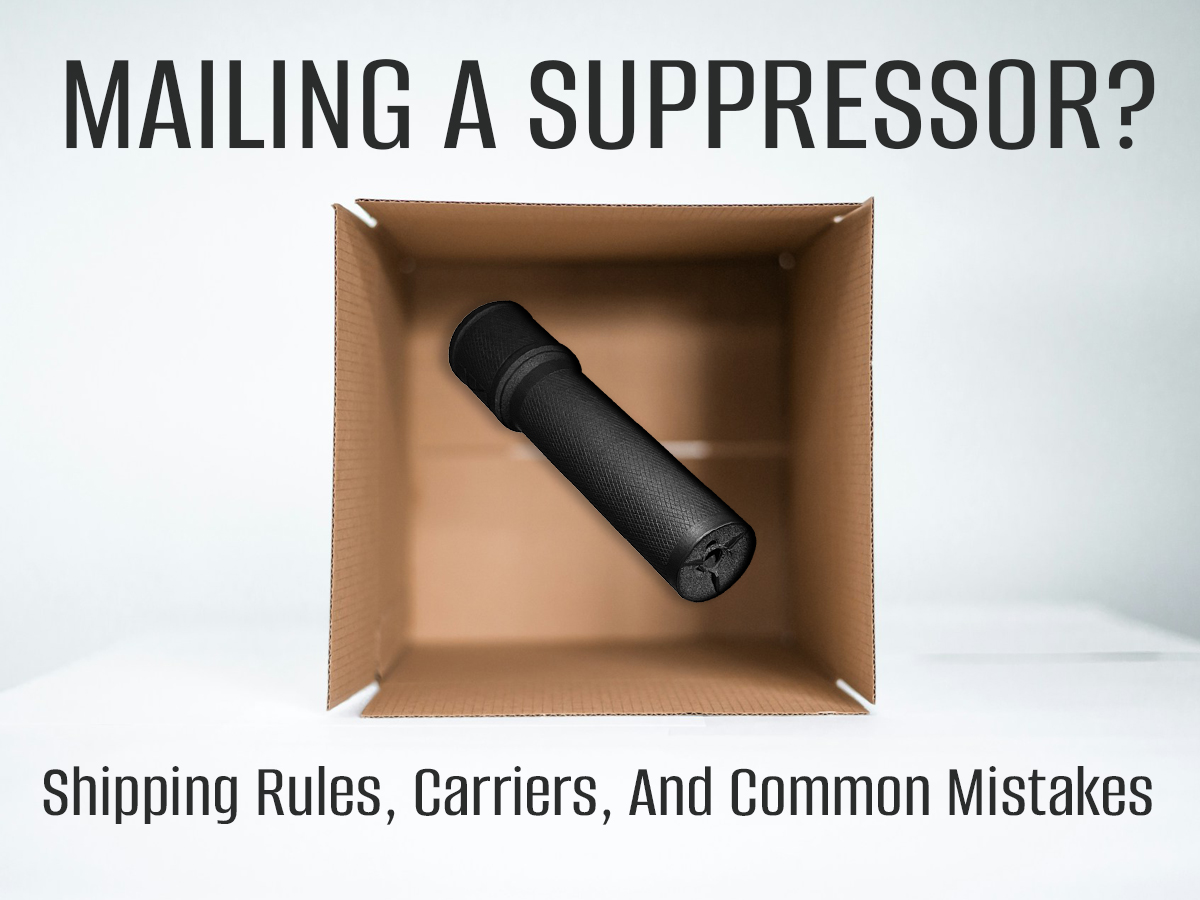
If you are thinking about mailing a suppressor, pause for one second and let the caffeine settle. This topic sits right where federal law, carrier policy, and expensive gear all love to cause drama. The good news: the rules do make sense once you separate “ownership,” “transfer,” and “shipping.” A suppressor counts as a firearm under federal definitions, and carriers treat it that way too.
Why Mailing A Suppressor Is Not The Same As Mailing Random Gear
A lot of people treat suppressor shipping like they are sending a scope mount, a sling, or a box of spare mags. That mindset creates trouble fast. Under federal law, a firearm muffler or silencer falls under the firearm definition, and ATF treats silencers as NFA firearms. USPS does too. UPS also says its firearm definition includes firearm silencers and mufflers.
That one point changes everything. It affects who can ship, which carrier may accept the package, where it can go, how you package it, and whether a transfer must go through an FFL/SOT. So yes, mailing a suppressor starts with one boring truth: this is not “just an accessory.” It is regulated hardware with paperwork attached.
That is also why ZastavaArms owners should approach the process with the same mindset they use for setup and alignment. The same care that makes the Zastava ZVUK Titanium AK Suppressor run right should also guide how you ship it.
What Federal Law Actually Means For Mailing A Suppressor
Federal law draws a bright line between lawful possession and lawful transfer. If you already own a registered suppressor, that does not mean you can box it up and send it anywhere you please. Any new transfer to another person usually requires ATF approval and the proper NFA process, typically through ATF Form 4 for tax-paid transfers. ATF’s current eForms page and Form 4 materials still reflect that structure.
That means mailing a suppressor to sell it across state lines is not a “ship first, paperwork later” situation. That idea belongs in the same trash can as “I’ll torque it by feel.” The lawful path usually runs through the proper dealer and approved NFA transfer process.
There is another important point that surprises people: ATF Form 20 interstate transport approval applies to machine guns, short-barreled rifles, short-barreled shotguns, and destructive devices. ATF’s eForms page lists Form 20 for those categories and does not list silencers in that filing requirement. The regulations search result also states that the requirement does not apply to the lawful interstate transportation of silencers.
So, in plain English, mailing a suppressor does not usually trigger the same Form 20 requirement that people know from SBR travel. That helps, but it does not erase transfer rules, state law, or carrier policy.
Can You Use USPS For Mailing A Suppressor?
Here is where people get tripped up by the word “mailing.” If you mean USPS specifically, the answer gets restrictive very fast.
USPS Publication 52 defines a firearm to include any firearm muffler or firearm silencer.
That matters because USPS firearm rules are much tighter than many people expect. In practice, nonlicensees should not assume they can walk into the post office and mail a suppressor like a normal parcel. Since USPS classifies silencers as firearms, you are in a regulated lane, not a casual retail lane.
So if your plan for mailing a suppressor starts with “I’ll just use USPS because the post office is closer,” that plan needs a hard reset. This is one of the biggest real-world mistakes owners make.
What UPS Allows Right Now
UPS states that its firearm definition includes firearm mufflers and firearm silencers. It also says UPS accepts firearm products only as a contractual service and only from licensed importers, manufacturers, dealers, or collectors to authorized recipients under an approved UPS agreement.
That means UPS is not an open-door option for everyone. UPS also requires adult signature services for firearm shipments, requires new corrugated packaging, prohibits ammo in the same package, and says the outer markings must not identify the contents as firearm products. UPS further says firearm products may be tendered only through scheduled pickup, on-call pickup, or certain approved return-label workflows, and they are not eligible for rerouting or UPS Access Point delivery.
So for mailing a suppressor with UPS, the short version looks like this: approved shipper, approved recipient, proper agreement, discreet packaging, no ammo, signature required, and no cute reroute tricks after drop-off.
What FedEx Allows Right Now
FedEx is even clearer. Its current U.S. page says the FedEx Service Guide prohibits firearm shipments unless FFL holders work with a FedEx account executive, obtain approval, and execute a Firearms Shipping Compliance Agreement. It also says unapproved shippers do not qualify, even if they hold an FFL.
FedEx also requires no ammunition in the package, secure internal packaging, a plain outer box, and either Adult Signature Required or Direct Signature Required. FedEx’s policy materials further say firearm shipments must go on a designated firearms account number and only to recipients with an active FFL.
That makes one thing very clear: for most regular owners, mailing a suppressor through FedEx is not a retail-counter errand. It is an approved-account, approved-shipper process.
When Mailing A Suppressor Usually Makes Sense
The most realistic lawful situations for mailing a suppressor usually fall into a few buckets.
First, you may deal with a dealer transfer. In that case, the suppressor moves through the FFL/SOT chain with ATF approval where required. Second, you may need to send the suppressor in for service or repair through a lawful channel. Third, you may receive a return shipment from a licensed party after lawful repair or service.
ATF’s older but still relevant NFA handbook and appendix materials discuss silencer repair and make clear that repairs live inside a regulated framework. ATF also distinguishes repair from replacement and treats silencer parts seriously.
So, if you have an issue with your can, do not improvise with “garage-lawyer logistics.” Start with the manufacturer or dealer instructions, confirm the current policy, and use the approved route.
That careful approach also matches the maintenance culture around Zastava’s suppressor lineup. Before you even think about shipping a can out, review your setup and support gear. A lot of “problem suppressors” turn out to be install, thread, or alignment issues rather than shipping-worthy disasters. Zastava has solid suppressor-specific resources, including ZVUK 101: What Makes Zastava’s Titanium AK Suppressor Different? and AK Alignment Rod: How to Use It to Prevent Baffle Strikes.
Packaging Rules That Save You Headaches
Good packaging will not fix a bad legal decision, but it will save you from avoidable damage and carrier trouble.
Start with the obvious one: no ammunition in the same box. UPS says ammo must ship separately from firearms, and FedEx says firearms cannot ship with ammunition.
Next, keep the outer box plain. UPS says outer markings must not identify the contents as firearm products, and FedEx says to use an outer box with no identifying markers.
Then protect the suppressor from internal movement. FedEx specifically says the item should sit secure enough that you do not hear movement when the box shifts.
For Zastava owners, that is where suppressor-specific accessories help in real life. The TITANIUM ZVUK SUPPRESSOR COVER helps protect the can during handling, and Hot Lock supports thread security on hot joints. For alignment checks before and after service, the Suppressor Alignment Rod for 7.62mm/30cal gives you a practical confirmation tool.
No, the cover does not turn your shipping box into a legal force field. It just helps you treat expensive gear like expensive gear, which is already a huge improvement over the “old towel and hope” method.
Common Mistakes People Make When Mailing A Suppressor
The biggest mistake is confusing ownership with shipping permission. “It’s mine” does not answer “may I send it this way to this person through this carrier.”
The second mistake is treating USPS, UPS, and FedEx like they all run the same policy. They do not. USPS classifies silencers as firearms, UPS limits firearm-product shipping to approved contractual licensee shippers, and FedEx limits firearm shipping to approved FFL shippers.
The third mistake is using a retail counter without confirming the current rules. That is a great way to waste an afternoon and create a paper trail of confusion.
The fourth mistake is sloppy packaging. Loose contents, branded markings, or ammo in the same package make a bad situation worse.
The fifth mistake is forgetting state and local law. Federal law is only one layer. Carriers themselves also tell shippers to comply with all applicable federal, state, and local law.
The sixth mistake is shipping a suppressor because you assumed the problem required factory service, when the real issue came from fitment, carbon lock, or alignment. Zastava has useful reading here too, including Using Zastava Alignment Rods to Prevent Baffle Strikes, How To Fix Carbon-Locked Suppressor, and ZVUK Cleaning Mistakes To Avoid.
A Smart ZastavaArms Owner’s Checklist
Before mailing a suppressor, ask these questions.
Do I actually need to ship it, or do I first need to verify alignment, carbon buildup, or thread condition?
Am I dealing with a transfer, a repair, or a return?
Does the recipient have the right status for this shipment?
Does the carrier policy allow this exact shipment from this exact type of shipper?
Did I remove all ammo and use a plain outer box?
Did I choose the required signature option?
Did I confirm current state and local law before I touched the label?
That list may sound boring, but boring is beautiful here. Boring avoids mistakes. Boring protects your registration trail. Boring keeps your Zastava setup out of legal limbo.
Why ZastavaArms Owners Should Think Beyond Shipping
A lot of suppressor trouble starts long before the box. It starts with setup, maintenance, and heat management. Zastava has built a nice ecosystem around the ZVUK, and that matters because it reduces the odds that you will need to ship a can out due to user-caused issues.
The Suppressors section and the AK Suppressor category give you a strong starting point for parts and support tools. If you run a compact setup, the ZPAP92 ZVUK Ready Combo 7.62X39mm shows how Zastava bundles practical pieces such as a hub adaptor, Hot Lock, alignment rod, and suppressor cover.
That kind of preparation makes ownership smoother. It also makes mailing a suppressor less likely to become an emergency project after a preventable issue.
Final Thoughts On Mailing A Suppressor
So, can you handle mailing a suppressor the easy way? Sometimes. Can you handle it casually? Absolutely not.
Suppressors sit in a tightly regulated category. ATF treats them as NFA firearms. USPS defines silencers as firearms. UPS and FedEx both impose strict firearm-shipping rules, and both carriers now limit those shipments to approved, regulated channels rather than ordinary walk-in retail shipping.
That sounds strict, but it also gives you a clean path: know what kind of shipment you are making, use the lawful channel, package it right, keep the box discreet, and confirm the current carrier rules before you act.
In other words, treat mailing a suppressor the same way you treat a good Zastava rifle setup. Check the details. Respect the system. Skip the shortcuts. Your wallet, your paperwork, and your blood pressure will all thank you.
If you want, I can also turn this into a cleaner CMS-ready version with no citations and with internal links spaced for direct publishing.